

Table of Contents
ToggleThe Strategic Framework of JIS G4305
In the global landscape of the “Foundation Industry,” the JIS G4305 standard, established by the Japanese Standards Association, is the definitive benchmark for cold-rolled stainless steel quality in Asia. For procurement professionals, this standard ensures that every coil or sheet meets rigorous criteria for chemical composition and mechanical integrity.
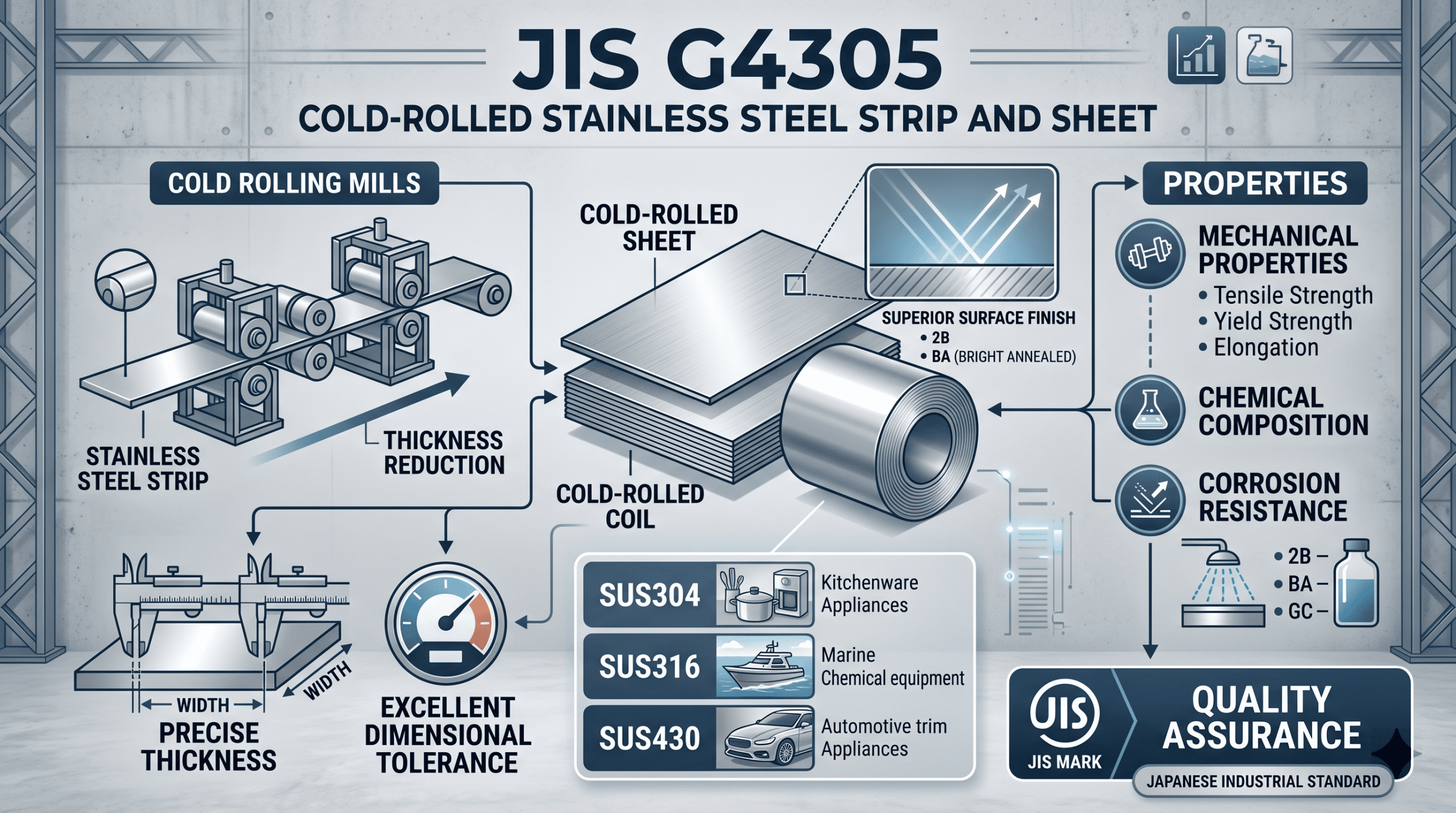
Unlike the JIS G4304 hot-rolled standard, JIS G4305 focuses on materials processed at room temperature. This results in several distinct technical advantages:
- Enhanced Surface Quality: Cold rolling eliminates mill scale, providing a smooth, clean surface essential for aesthetic and sanitary applications.
- Precision Tolerances: It allows for much tighter thickness controls, typically ranging from 0.3mm to 3.0mm, which is critical for automated stamping.
- Improved Mechanical Properties: The process induces strain hardening, increasing the material’s yield strength and hardness compared to hot-rolled alternatives.
Procuring materials that adhere to JIS G4305 reduces risks by providing international compatibility with standards like ASTM A240 and EN 10088, facilitating seamless multi-regional supply chain management.

Deep Dive: Material Grade Selection & Metallurgy
Selecting the correct grade is the cornerstone of a successful procurement strategy. JIS G4305 categorizes steel primarily into Austenitic (300 series) and Ferritic (400 series) groups.
The Austenitic Powerhouse (300 Series)
- SUS304 (The Universal Standard): Comprised of 18% Chromium and 8% Nickel, this is the most widely used grade due to its excellent corrosion resistance and formability. It is the default choice for food processing equipment and general industrial components.
- SUS316/316L (The Marine Grade): By adding 2-3% Molybdenum, these grades provide superior resistance to chloride-induced pitting. They are non-negotiable for chemical processing, medical devices, and coastal environments.
- SUS304L/316L (Low Carbon): These versions restrict carbon to 0.03% or less to prevent intergranular corrosion during welding, ensuring the longevity of welded structures.
The Ferritic Efficiency (400 Series)
- SUS430: This nickel-free grade is magnetic and offers a significant cost advantage – typically 30-40% cheaper than SUS304. It is ideal for indoor appliances and automotive trim where extreme corrosion resistance isn’t required.
Specialty Grades for Extreme Conditions
- SUS321: Contains Titanium to provide high-temperature stability, making it suitable for environments between 400°C and 900°C.
- SUS310S: High Chromium and Nickel content allows for oxidation resistance at temperatures exceeding 1000°C, a prerequisite for industrial furnaces.
- SUS301: Known for its high elasticity and strength, it is the primary choice for precision springs and gaskets.
JIS G4305 Grade Comparison & Procurement Logic
Grade | Primary Alloy | Key Technical Benefit | Primary Application | B2B Procurement Insight |
SUS304 | 18Cr-8Ni | Universal corrosion resistance | Food & General Industry | Highest availability; stable pricing |
SUS316L | 18Cr-12Ni-2Mo | Best for harsh chemicals | Marine & Medical | Critical for longevity in salt/acid |
SUS430 | 17Cr | Economic & Magnetic | Household Appliances | Best for budget-sensitive projects |
SUS321 | 18Cr-8Ni-Ti | Thermal stability | Exhaust & Heat systems | Specialized for 400-900°C |
SUS301 | 17Cr-7Ni | High tensile strength | Springs & Fasteners | For mechanical tension needs |
Surface Finishes and Specification Management
For many B2B applications, the surface finish is just as important as the alloy. JIS G4305 defines several standard finishes that balance aesthetics with functional performance.
- 2B (Standard Industrial): A smooth, greyish finish that is the most economical and widely stocked. It serves 80% of industrial needs.
- BA (Bright Annealed): A high-gloss, mirror-like finish produced without mechanical polishing. It is preferred for high-end decorative and medical uses.
- No. 4 (Brushed): Characterized by short, uniform linear textures, it is excellent for hiding fingerprints on appliances.
- HL (Hairline): Features long, continuous streaks, providing a sophisticated look for architectural elevators and facades.
- 8K (True Mirror): The highest reflectivity possible, reserved for luxury decorative project
JIS G4305 Surface Finish Decision Matrix
Surface Finish | Visual Characteristic | Application | Cost Factor (vs 2B) |
2B | Moderate Luster | General Industrial | Base Price |
BA | Mirror-bright | Medical/High-end Decor | +8-15% |
No. 4 | Brushed/Matte | Kitchen/Home Appliances | +5-10% |
HL | Fine continuous lines | Elevators/Architecture | +8-13% |
8K | Ultra-reflective | Luxury Design | +20-30% |
FAQ
Q1: Can JIS G4305 materials be substituted with ASTM A240?
In most cases, yes. While they are chemically similar, JIS G4305 often specifies tighter tolerances for thin-gauge sheets. Always verify specific mechanical properties on the Mill Test Certificate (MTC).
Q2. Why is my "non-magnetic" SUS304 material showing magnetic pull?
Cold-rolled austenitic steel can develop magnetism due to strain-induced martensitic transformation during processing. This is a normal physical property and does not indicate poor material quality.
Q3. How do I ensure material traceability for a high-stakes project?
Always require an MTC that matches the heat number stamped on the material. At Genn-Hann, our ERP system ensures 100% traceability from the mill to your doorstep.
Q4. What are the risks of using non-standard thicknesses?
Custom thicknesses often lead to 10-20% higher costs and significantly longer lead times. Utilizing standard thicknesses (0.5mm, 0.8mm, 1.0mm, etc.) ensures the best price and supply stability.
Q5. How should JIS G4305 materials be stored to prevent degradation?
Store in a dry, ventilated environment and avoid direct contact with carbon steel to prevent cross-contamination. For finished surfaces, ensure the protective film is removed within the recommended timeframe to avoid adhesive residue.
Why Choose Genn-Hann Stainless Steel ?
With over 45 years of experience since 1980, Genn-Hann Stainless Steel has evolved into a cornerstone of the Taiwan stainless steel industry.
- Certified Excellence: We hold ISO 9001 and TOYOTA factory certifications, serving over 1,000 corporate clients globally.
- Precision Processing: We operate multiple advanced slitting and shearing lines, capable of precision within ±0.05mm.
- Comprehensive Supply: From 200 to 400 series, and thicknesses from 0.3mm up to 8.0mm, our stock is managed to ensure 3-5 day delivery for common specs.
- Quality Assurance: We provide full MTCs and can arrange third-party testing (SGS/BV) to guarantee your peace of mind.
As your partner in digital transformation and foundation industry growth, Genn-Hann doesn’t just sell steel – we provide the material certainty that fuels your innovation.
Extended Reading & Reference Resources
Contact Us
EN 10088 is a European stainless steel standard series published by the European Committee for Standardization (CEN), while ASTM A240 is the North American standard published by ASTM International. Although the two standards cover largely equivalent steel grades, they differ in allowable chemical composition tolerances, surface condition designation codes, dimensional tolerance classes, and material certificate requirements. Buyers sourcing material for European market applications or CE-certified products must explicitly specify EN 10088 compliance — not ASTM — and require the corresponding inspection certificate from their supplier. Substituting ASTM-compliant material without confirming EN 10088 equivalence can result in non-compliance during downstream audits or product certification.